 Land O'Lakes Siding
 Siding in Suncoast Meadows Has a Tougher Job Than It Looks
Homes in Suncoast Meadows sit in one of the more demanding climates in the country for an exterior wall covering. Land O'Lakes and the rest of Pasco County get the full package: long stretches of intense subtropical sun, heavy summer humidity, wind-driven rain from afternoon storms, and the real possibility of hurricane-force wind loads during the June-to-November season. Add in salt-laden air that moves inland off Tampa Bay and the Gulf on a south or southwest breeze, and you have conditions that will find every weakness in a wall system within a few years, not a few decades.
Siding isn't just a cosmetic layer here. It's the first line of defense against water intrusion, wood rot, and wind damage for the framing and sheathing behind it. When we talk with homeowners in Suncoast Meadows about a siding project, the conversation almost always starts with "what's actually going to hold up," not just "what looks good." This page is about that question, specifically for this neighborhood and this climate — what a correct James Hardie installation involves, how our process works here, and why the crew doing the work matters as much as the material itself.
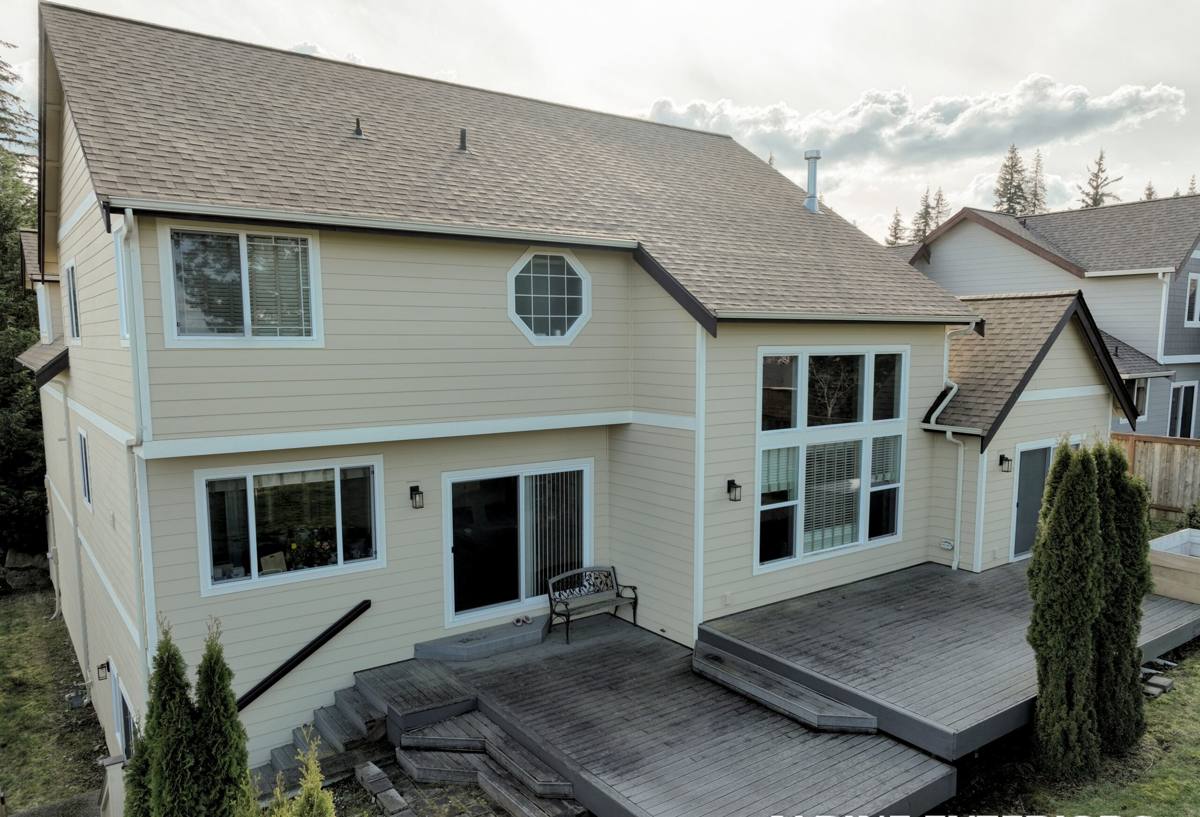
What Actually Wears Down Siding in This Climate
Wind-Driven Rain and Moisture Intrusion
Florida rain rarely falls straight down. Afternoon thunderstorms push rain sideways under eaves, around trim, and into any gap or seam that isn't properly flashed. Over time, siding that wasn't installed with the right water-resistive barrier, flashing, and lap details lets moisture behind the cladding — and once water gets behind a wall system in a humid climate, it doesn't dry out quickly. That's when you start seeing soft trim, stained sheathing, and eventually structural rot.
Relentless UV and Heat Cycling
Central Florida gets a lot more direct sun exposure than most of the country, and siding faces it year-round, not just in summer. UV breaks down pigments and surface coatings, which is why cheaper paint jobs and lower-grade products chalk, fade, and crack unevenly — usually worse on south- and west-facing walls. Add daily heat cycling (hot sun, sudden downpour, cooling at night) and any material that expands and contracts more than its fasteners and joints can handle will eventually show gaps, warping, or popped fasteners.
Hurricane-Force Wind Loads
Pasco County sits in a wind zone where siding has to be installed to resist significant uplift and lateral pressure, not just look good on a calm day. Improperly fastened panels, wrong fastener spacing, or missing structural attachment points are exactly the kind of shortcuts that turn into siding literally peeling off a wall during a tropical storm or hurricane — often taking house wrap and insulation with it.
Humidity and Organic Growth
High ambient humidity for much of the year gives mold, mildew, and algae plenty of opportunity to take hold on porous or absorbent siding surfaces, especially in shaded areas of a lot or on the north side of a home. That's a maintenance burden as much as an appearance issue, since organic growth left unaddressed can hold moisture against the surface longer.
Why We Install Only James Hardie Fiber Cement
James Hardie siding is made from a blend of Portland cement, sand, and cellulose fiber, pressed and cured into a dense, dimensionally stable board. That composition is a direct answer to everything listed above: it doesn't warp or swell the way wood-based products can when they take on moisture, it's non-combustible, and it holds its shape through Florida's heat-and-rain cycling far better than materials built around wood fiber or vinyl.
James Hardie also engineers specific product lines for different climate zones through its HZ5 formulation, which is designed for hot, humid regions like ours — built with moisture and pest resistance appropriate to Gulf Coast conditions rather than a one-size-fits-all national spec. The factory-applied ColorPlus finish is baked on and cured before the boards ever reach a job site, which gives far better, more even UV and fade resistance than field-applied paint, and it comes with its own finish warranty backed by the manufacturer.
We don't install LP SmartSide, vinyl, Cemplank, Allura, or primed wood siding, and that's a deliberate standard, not an oversight. Each of those products has legitimate uses elsewhere, but for the wind loads, UV exposure, and moisture demands we see in Pasco County, we've found the trade-offs — whether that's a wood-based core's moisture sensitivity, vinyl's heat distortion and impact limits, or a shorter effective service life — aren't ones we're willing to put our name behind. James Hardie is what we've standardized on because it holds up here, and it's backed by a strong transferable warranty when installed to spec.
What a Correct Installation Actually Involves
The material only performs as well as the install. Most of the siding failures we get called out to inspect in this area trace back to installation shortcuts, not the product itself. A correct James Hardie job includes:
Water-Resistive Barrier and Flashing
A continuous, properly lapped water-resistive barrier goes on before any siding, with flashing integrated at every window, door, and penetration so water is directed out and down, never trapped behind the cladding. This is the single most common corner cut on rushed jobs, and it's invisible once the siding goes up — which is exactly why it matters who's doing the work.
Fastening for Wind Resistance
Fastener type, spacing, and placement all follow James Hardie's published specifications for our wind exposure category, not a generic pattern. Under-fastened or improperly placed nails are a leading cause of panels lifting or failing in high wind.
Clearances and Expansion Gaps
Hardie board needs proper clearance from grade, roofing, decks, and other flatwork, plus correct gapping at butt joints and trim to allow for the material's normal expansion and contraction. Skipping these clearances is a common source of moisture wicking and premature deterioration at the bottom edge of a wall.
Joint Treatment and Sealant
Butt joints, trim intersections, and penetrations get sealed with a sealant compatible with ColorPlus finishes and rated for exterior movement — not whatever caulk happens to be in the truck. Incompatible sealants can void warranty coverage and fail well before the siding does.
Our Process for a Suncoast Meadows Project
On-Site Assessment
We start by walking the exterior and looking at what's actually happening behind the current siding where accessible — trim condition, evidence of past water intrusion, soffit and fascia condition, and how the home's orientation and landscaping affect sun and rain exposure. This tells us more about what the home needs than a generic estimate ever could.
Tear-Off and Substrate Prep
Old siding and any compromised sheathing or trim come off and get replaced before new material goes on. Installing over rot or wet substrate just locks the problem behind a new wall.
Installation to Manufacturer Spec
Panels, trim, and accessories go on following James Hardie's published installation instructions for our region and exposure — barrier, flashing, fastening, clearances, and joint treatment, in that order, done right the first time.
Final Inspection and Cleanup
We walk the finished job looking specifically for fastener placement, joint sealing, and trim details before calling it complete, and we clean the site thoroughly before we leave.
How James Hardie Compares to Other Siding Materials
Homeowners often ask us to explain, plainly, why we standardized on one product instead of offering a menu of options. This table lays out the factors that matter most for our climate:
| Material | Wind Resistance | Moisture/Rot Resistance | UV/Color Retention | Fire Rating |
|---|---|---|---|---|
| James Hardie fiber cement (HZ5) | Engineered for high-wind attachment specs | Cement-based core, not wood-based | Factory-baked ColorPlus finish | Non-combustible |
| Vinyl siding | Can deform or detach under sustained high wind | Doesn't rot, but seams can allow water behind panels | Can fade and become brittle under prolonged UV/heat | Combustible plastic |
| LP SmartSide / engineered wood | Adequate when new, fastener-dependent | Wood-strand core sensitive to sustained moisture | Requires field-applied paint maintenance | Combustible (treated) |
| Traditional wood/cedar | Fastener and panel-size dependent | Prone to rot and pest damage without upkeep | Needs regular refinishing | Combustible |
This isn't a claim that other products can't be installed correctly by someone — it's why our crew, specifically, chose to specialize in one system we can stand behind for this climate rather than spreading our expertise across several.
What to Expect Long-Term: Maintenance and Lifespan
One reason we like James Hardie for Pasco County homes is how little ongoing maintenance it asks for compared to wood-based alternatives. There's no repainting cycle to keep up with the way there is with wood or primed siding — the ColorPlus finish is designed to hold its color for years under direct sun exposure. Homeowners should still plan on periodic rinsing to keep pollen, salt residue, and organic growth from building up, and an annual visual check of caulking and trim joints is good practice in any Florida climate. Beyond that, a correctly installed system is built to go a long time between any real work.
Why It Matters That Your Crew Already Works in Suncoast Meadows
Siding crews that regularly work a specific neighborhood pick up on things a first-time visitor wouldn't. In Suncoast Meadows, that means understanding how the homes here are laid out and oriented, what the common construction vintage and wall assemblies look like, and how they've actually held up against real Pasco County weather rather than a spec sheet. It also means knowing the permitting process through Pasco County and any HOA architectural review steps for the community before a single piece of siding gets ordered, so the project doesn't stall halfway through on paperwork. A crew that's already done work in the area isn't guessing at any of this — they've done it before, on this street, in this weather.
Signs Your Suncoast Meadows Home May Need New Siding
Not every siding problem is obvious from the street. A few things worth checking, especially before or after storm season:
- Soft spots, bubbling, or visible warping anywhere on the siding surface
- Persistent staining or streaking that doesn't wash off, especially near trim and seams
- Cracked, chalking, or badly faded paint, particularly on south- and west-facing walls
- Gaps opening up at butt joints, corners, or trim where sealant has failed or pulled away
- Visible mold, mildew, or algae buildup that keeps returning after cleaning
- Any panels that feel loose, rattle in wind, or show fastener heads working their way out
- Interior signs like peeling paint, musty odor, or soft drywall near exterior walls
If more than one or two of these apply, it's worth having the wall assembly looked at rather than just the surface — moisture problems behind siding tend to get worse, not better, on their own.
Questions Worth Asking Before You Hire
Because so much of what makes a siding job last is invisible once it's finished, it's worth asking a contractor directly about the details rather than judging the estimate on price alone:
| Question | Why It Matters |
|---|---|
| What water-resistive barrier and flashing method do you use? | This determines whether water actually stays out of the wall assembly |
| Are you following James Hardie's published fastening spec for our wind zone? | Under-fastened siding is a leading cause of storm damage |
| Do you pull permits and handle HOA architectural review? | Skipped permitting can create problems at resale or claim time |
| What's covered under the manufacturer warranty versus your workmanship warranty? | These are two separate things and both should be in writing |
A contractor who works this neighborhood regularly should be able to answer all of these without hesitation, since it's the same conversation they've had with other Suncoast Meadows homeowners before.
If your Suncoast Meadows home's siding is showing its age, or you're planning ahead of the next storm season, we're happy to take a look and walk you through what a correct James Hardie installation would involve for your specific home. The estimate is free, there's no pressure, and you'll get a straight answer about what your siding actually needs — just fill out the form below to get started.