 Land O'Lakes Siding
 Siding Built for Oakstead's Corner of Pasco County
Oakstead is one of the larger established residential communities in Land O'Lakes, and homes here run the gamut from late-1990s construction to newer builds going up along the SR 54 corridor. Whatever the vintage, every one of those houses is fighting the same battle: Central Florida weather doesn't take a day off. Between the summer heat, the afternoon thunderstorms that roll in almost daily from June through September, and the occasional tropical system that sends sustained wind and driving rain sideways across a roofline, exterior materials in this part of Pasco County get tested constantly. Siding that looks fine in a showroom in Atlanta or Ohio doesn't always hold up the same way once it's on a wall in Land O'Lakes.
We're a local exterior contractor working siding, roofing, windows, and decks across the Land O'Lakes area, including Oakstead. This page walks through what the climate actually does to exterior materials here, why we standardized on James Hardie fiber cement siding instead of the alternatives, and what a straightforward siding project looks like from start to finish.
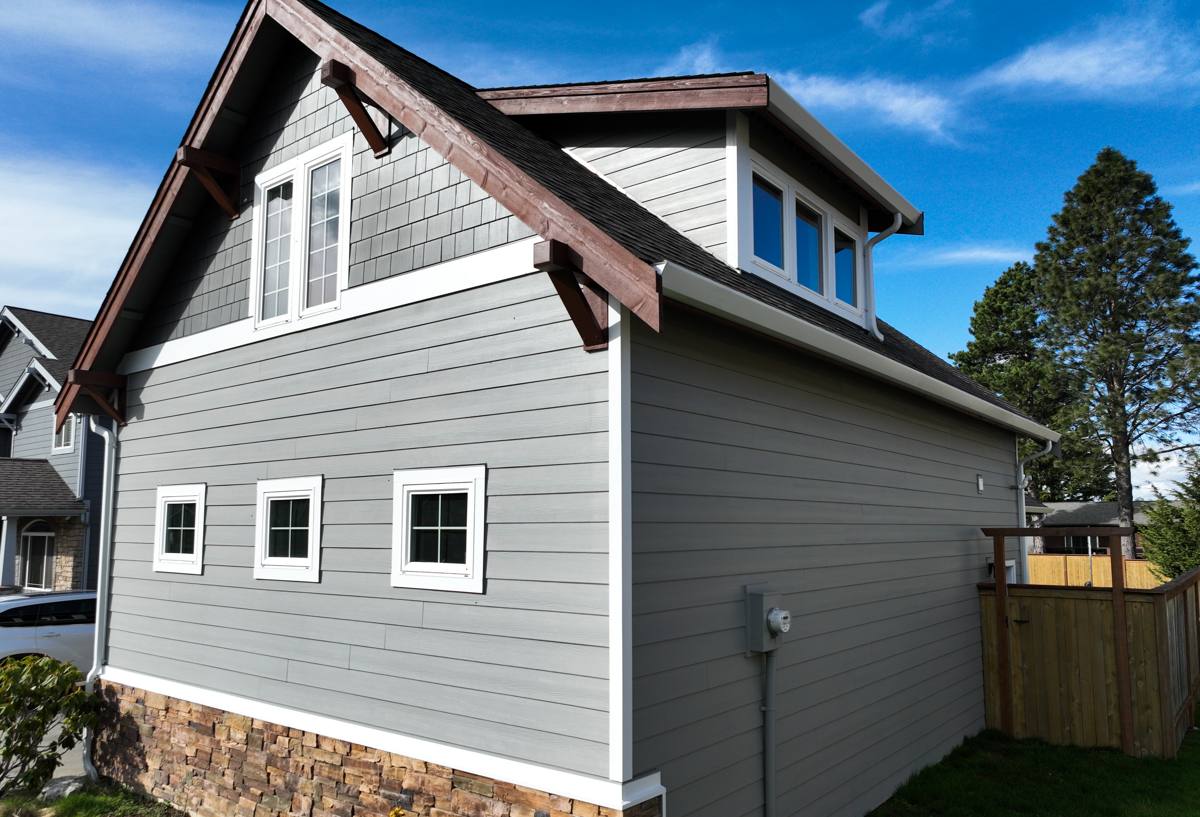
What Pasco County Weather Does to a Home's Exterior
UV Load, Almost Year-Round
Florida's sun angle and the sheer number of clear, high-UV days per year mean exterior materials get more ultraviolet exposure here than in most of the country. Paint fades faster, caulk gets brittle sooner, and any material with a factory finish that isn't rated for this kind of UV load will chalk, dull, or crack years ahead of schedule. This is one of the most underestimated factors homeowners run into when they choose a siding product based on a sample from a cooler climate.
Wind-Driven Rain
Land O'Lakes sits far enough inland that it isn't dealing with direct surf and spray, but it absolutely deals with wind-driven rain — the kind of storm where rain isn't just falling, it's being pushed horizontally into a wall by sustained gusts. That matters because wind-driven rain finds every weak seam, every gap in flashing, and every spot where a siding product's water-management design falls short. A material that performs fine in a light vertical rain can behave very differently when the same water is being driven sideways at 40+ mph.
Hurricane-Force Wind Events
Pasco County isn't immune to tropical systems, and even when a storm's center passes well offshore or inland to the east, Land O'Lakes can still see hurricane-force gusts, prolonged tropical-storm-force wind, and heavy rain bands. Siding attachment, fastening pattern, and the product's own wind rating all matter here — this isn't a cosmetic decision, it's a structural one.
Humidity and Moisture Cycling
High year-round humidity means exterior materials rarely get to fully dry out between rain events. Products that absorb moisture, swell, or are vulnerable to rot need real diligence to manage in this climate — caulking schedules, paint maintenance, and moisture barriers all become more important than they would be in a drier region.
Why We Install Only James Hardie Fiber Cement
We made a deliberate decision as a company to install James Hardie siding exclusively — not vinyl, not LP SmartSide, not Cemplank, not Allura, not primed wood. That's not a marketing gimmick; it's a standard we hold because of what we've seen happen to Florida homes over the years, and because of how each of those products stacks up against the specific stresses described above.
- Non-combustible material — fiber cement doesn't burn, which matters for insurance conversations and general home safety.
- Engineered for humid, high-UV climates — Hardie's HZ5 product line is specifically formulated for hot, humid regions like Florida, addressing moisture and heat performance that generic fiber cement or wood-based products aren't built around.
- Factory-applied ColorPlus finish — baked-on color with UV-resistant resins holds up to Florida sun dramatically better than field-applied paint, and it's backed by its own finish warranty.
- Dimensionally stable — fiber cement doesn't expand, contract, or absorb moisture the way wood-based composite products can, which matters through Pasco County's humidity swings.
- Strong, transferable warranty — when installed to Hardie's specifications, the product carries a long-term warranty that can transfer to a new owner, which matters if you ever sell.
We're not going to tell you every other siding product is junk — some of them have real strengths, and we're happy to talk through the trade-offs honestly if you ask. But when we weigh installation sensitivity, long-term moisture behavior, maintenance burden, and how a product actually performs after ten Florida summers, Hardie is what we're willing to put our name behind and warranty our labor against.
What Correct Hardie Installation Looks Like
A siding product is only as good as its installation, and this is where a lot of problems on Florida homes actually originate — not from the material itself, but from shortcuts taken putting it up. Hardie publishes detailed installation specifications, and following them isn't optional if you want the warranty to mean anything.
- Proper water-resistive barrier installed behind the siding, lapped correctly to shed water downward.
- Correct fastening pattern and fastener type — this directly affects wind performance and is one of the most commonly skipped details on rushed jobs.
- Proper clearance at grade, roofline, and around all penetrations (outlets, hose bibs, vents) so water has somewhere to go instead of sitting against the material.
- Correctly sized gaps and joints, caulked and sealed per manufacturer spec, not just "close enough."
- Flashing detail at windows, doors, and any horizontal trim transitions — this is where most water intrusion problems actually start on any home, regardless of siding brand.
We install to these specifications as our baseline, not as an upsell. A crew that's used to working in Central Florida understands why each of these steps matters more here than it might in a drier, calmer climate.
Siding Is Rarely a Standalone Decision
Because we also handle roofing, windows, and decks, we tend to look at a home's exterior as one connected system rather than isolated projects. That matters in a neighborhood like Oakstead for a practical reason: siding, roofline, and window flashing all interact at the same transition points, and problems in one often show up as damage in another.
Roofing
Roof edges, drip edge, and fascia details connect directly to siding termination points. If a roof is nearing the end of its service life or has flashing issues, that's often the actual source of a "siding" leak.
Windows
Window flashing and siding installation have to be sequenced correctly — siding installed around windows that aren't properly flashed will trap water rather than shed it, regardless of how good the siding material is.
Decks
Exterior decks in this climate face their own UV and moisture exposure, and where a deck ledger board attaches to the house, correct flashing is just as important as it is anywhere else on the exterior envelope.
You don't need all four services at once — plenty of our Oakstead projects are siding-only. But when we're on-site, we'll flag anything we see in roofing, windows, or decking that's likely to undermine a new siding job, because it's a disservice to install great siding next to a flashing problem we noticed and didn't mention.
What Affects Siding Project Cost
Every home is different, but these are the main factors that move the price on a siding job, whether it's a full replacement or a partial repair-and-match:
| Factor | Why It Matters |
|---|---|
| Home size and complexity | More linear footage, more corners, more gables — more material and labor |
| Siding profile | Lap siding, board-and-batten, and shingle-style Hardie profiles differ in material and install time |
| Existing substrate condition | Rotted sheathing or old moisture damage found during tear-off adds repair scope |
| Trim and detail work | Window and door trim, corner boards, and fascia detail add labor beyond flat wall area |
| Color and finish | Factory ColorPlus finishes vs. field-painted primed siding affect material cost and long-term maintenance |
| Access and site conditions | Fencing, landscaping, pools, and tight lot lines can affect staging and labor time |
We give honest, itemized estimates and won't quote a number without actually seeing the home — anyone quoting a firm price over the phone sight-unseen is guessing.
What to Look for in a Local Contractor
Oakstead homeowners have plenty of contractor options, and it's worth being deliberate about who you hire for exterior work — a bad siding install can cause moisture problems that don't show up for years. A few things worth checking before you sign anything:
- Proper licensing and insurance for exterior contracting work in Florida
- Manufacturer training or certification on the specific siding product being installed
- A written scope of work that specifies flashing, fastening, and water-management details — not just "install siding"
- Local references or a local track record, since a crew unfamiliar with Florida-specific detailing is more likely to miss climate-relevant steps
- A clear warranty that covers both material and labor, and clarity on what voids it
A local crew that works this climate every week understands things a traveling or out-of-area contractor may not — how wind-driven rain behaves during a summer storm, how much clearance to leave at grade given our rainfall patterns, and which details actually matter versus which ones are just extra steps.
Ready to Talk About Your Home in Oakstead
If you're noticing fading, cracking, warping, or moisture issues on your current siding, or you're just starting to plan ahead, we're happy to take a look and give you a straight answer about what your home actually needs. Reach out for a free, no-pressure estimate — we'll walk the exterior with you, point out anything worth knowing, and explain your options in plain terms.