 Land O'Lakes Siding
 Why Decks in Trinity Wear Out Faster Than Homeowners Expect
Trinity sits inland from the coast, but that doesn't spare it from the punishment Florida weather puts on outdoor structures. Between the long stretch of intense summer UV, the sudden afternoon downpours that soak a deck and then let it bake dry within an hour, and the occasional tropical system that brings hurricane-force gusts through Pasco County, a deck here works harder than the same structure would almost anywhere else in the country. Add humidity that never really lets wood dry out completely, even overnight, and you have a recipe for hidden rot, loosening fasteners, and surface damage that shows up years before it would in a drier climate.
Most homeowners don't notice the slow decline until something forces the issue — a soft spot underfoot, a railing that wiggles, or a board that's visibly cupped and splintering. By the time those signs show up on the surface, the structure underneath has usually been compromised for a while. That's the pattern we see repeatedly on decks throughout this part of Land O'Lakes, and it's why replacement, done correctly, is as much about what's underneath the boards as what you see on top.
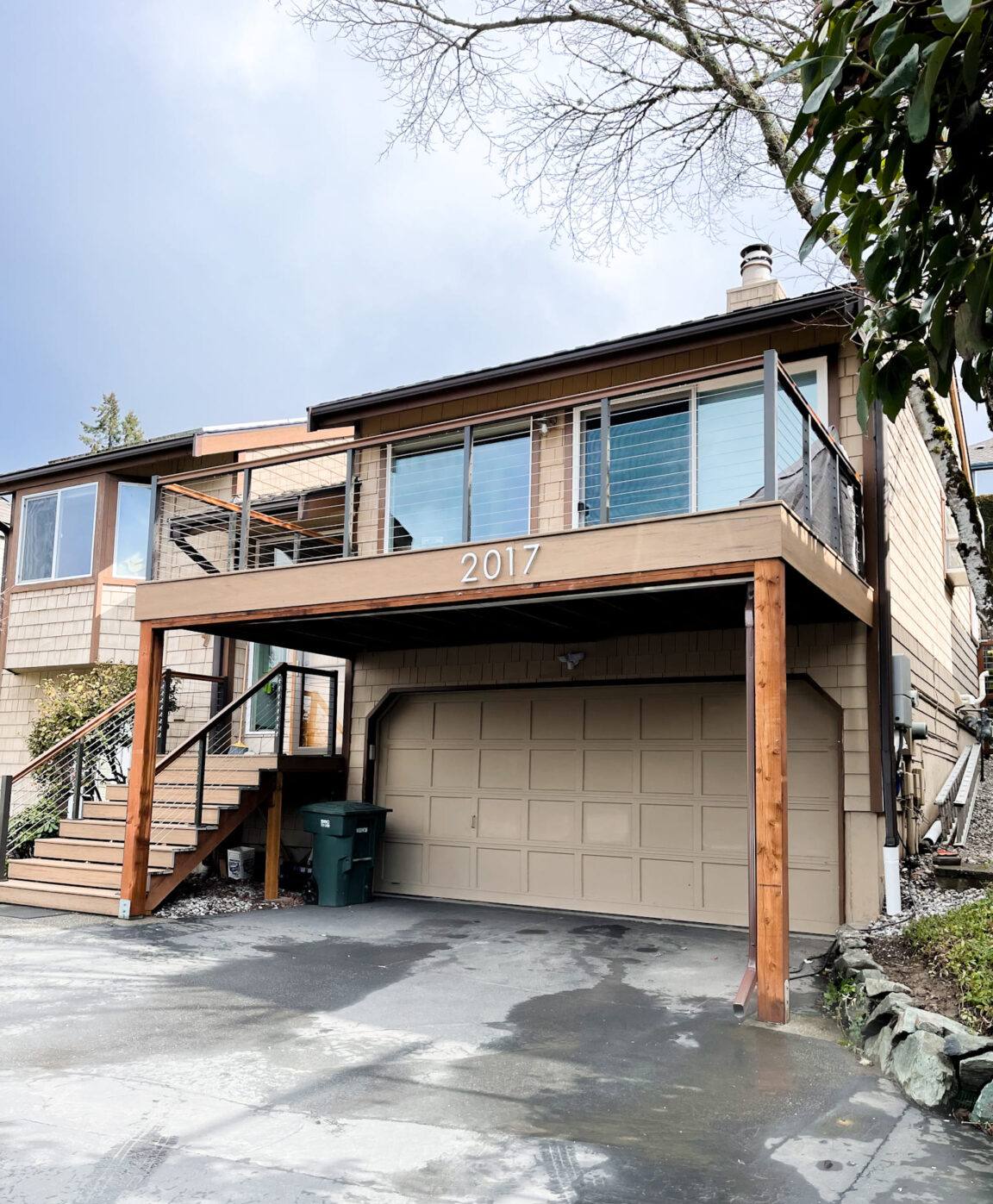
Signs a Trinity Deck Needs Full Replacement, Not Another Repair
Not every tired-looking deck needs to be torn out. But there's a point where patching individual boards is just delaying an inevitable, more expensive failure. Here's what tells us a deck has crossed that line:
- Soft, spongy, or bouncy spots in the decking or framing when you walk across it
- Visible rot or insect damage at the ledger board (where the deck attaches to the house)
- Rusted, corroded, or pulling fasteners — common after repeated wet-dry cycles
- Posts or footings that have shifted, settled unevenly, or show cracking
- Railings that flex or feel loose, which is a safety issue, not just cosmetic
- Widespread cupping, splitting, or graying that sanding and staining won't fix
If the problems are isolated to a few boards and the frame underneath is sound, repair can make sense. If the ledger board, joists, or footings are compromised, repair is a short-term patch on a structural problem — and that's when full replacement is the honest recommendation.
Choosing Decking Material for This Climate
The material decision matters more in Pasco County than it does in a lot of other markets, simply because the combination of UV exposure, humidity, and wind-driven rain is tougher on some products than others. There's no single "best" material for every homeowner — it depends on budget, how much upkeep you're willing to do, and how long you want to go before the next major project.
| Material | UV & Heat Behavior | Moisture Behavior | Maintenance |
|---|---|---|---|
| Pressure-treated wood | Fades and grays without regular finish | Prone to swelling/shrinking with humidity cycles; needs sealing | Annual cleaning and re-staining recommended |
| Composite decking | Holds color better; some lower-grade products can still fade | Resists rot but can trap moisture at fastener points if not installed correctly | Periodic cleaning; no staining or sealing required |
| PVC/capped composite | Strong UV and fade resistance | Fully resists moisture absorption and rot | Lowest maintenance; higher upfront cost |
| Tropical hardwoods | Naturally dense, holds up to sun | Good natural moisture resistance | Requires periodic oiling to maintain appearance |
We install a range of these depending on what a homeowner is after, but we're upfront about trade-offs rather than pushing whatever has the best margin. Lower-grade composite products, for example, can look great on day one but behave poorly around fasteners and framing connections if the installer isn't accounting for how they expand and contract in Florida heat. That's an installation issue as much as a product one, and it's exactly the kind of detail that separates a deck that lasts from one that doesn't.
Wood vs. Composite: The Honest Trade-Off
Wood costs less upfront and has a classic look, but it demands real maintenance discipline in a climate that alternates between soaking rain and intense sun almost daily for much of the year. Skip a season of sealing and you're often looking at accelerated graying, splitting, or splintering. Composite and PVC cost more initially but shift the ongoing burden away from maintenance and toward upfront investment — a trade a lot of Trinity homeowners are willing to make once they've been through a wood deck's maintenance cycle once or twice.
What a Correct Deck Replacement Actually Involves
A deck replacement that's built to last in this climate goes well beyond swapping old boards for new ones. The parts nobody sees are the parts that determine whether the deck is still solid in ten years:
- Ledger board flashing — proper flashing where the deck meets the house prevents water intrusion into the house structure itself, not just the deck
- Joist protection — treating or capping joists reduces the wood's exposure to standing moisture after heavy rain
- Fastener selection — corrosion-resistant, coated fasteners rated for treated lumber and coastal-influenced humidity, not standard hardware store screws
- Footing depth and post connections — sized and set to hold against wind uplift, per code, not just what's "always been done"
- Proper board spacing — accounting for material expansion in summer heat so boards don't buckle
- Railing and stair structural connections — the most common point of failure in older decks and the most important for safety
Skipping any of these to save time or cost is how a deck ends up needing structural repair again in five years instead of holding up for two or three decades.
Our Process, Start to Finish
1. On-Site Assessment
We look at the existing structure — not just the decking surface — to determine whether the frame, ledger, and footings are salvageable or need to come out along with the boards. This is also when we talk through material options based on your budget and how much maintenance you want to take on long-term.
2. Clear, Written Estimate
You get a scope of work and price before anything starts, including what's being replaced structurally versus cosmetically, so there's no ambiguity about what you're paying for.
3. Demolition and Structural Correction
Old decking, and any compromised framing or footings, come out. This is where hidden rot or undersized structural elements from the original build typically get discovered and corrected.
4. Rebuild to Code
Framing, flashing, fasteners, and footings go in to current code requirements for Pasco County — not just matched to whatever was there before, which may have been built to an older or looser standard.
5. Decking, Railing, and Finish Work
Surface material goes down last, with attention to spacing, fastener pattern, and railing rigidity, followed by a final walkthrough with you before we call it done.
What Affects the Cost of a Deck Replacement
| Factor | Why It Matters |
|---|---|
| Deck size and shape | Multi-level decks, curves, and built-in features add labor beyond simple square footage |
| Material choice | Pressure-treated wood costs less upfront; composite and PVC cost more but reduce future upkeep |
| Framing and footing condition | Replacing compromised structural elements adds cost but is not optional if safety is at stake |
| Railing style and code requirements | Height, baluster spacing, and stair requirements affect materials and labor |
| Site access | Decks with limited access for equipment or material staging take longer to build |
We'd rather walk you through these factors on-site and give you a real number than throw out a broad estimate that doesn't hold up once we're actually looking at your structure.
Permitting and Code in Pasco County
Deck replacement in this area typically requires a permit, especially when structural elements like framing, footings, or railings are involved — which is nearly always the case in a full replacement. Permits exist to make sure the structure can actually handle Florida's wind loads and that railings and stairs meet safety requirements. We handle the permitting process as part of the job rather than leaving it for the homeowner to sort out, and we build to the load and connection standards that apply in this county, not a generic national minimum.
Maintenance Checklist Once Your New Deck Is In
- Rinse off debris, pollen, and organic buildup every few weeks, more often in rainy season
- Check railing and stair connections for looseness once or twice a year
- For wood decks, plan on re-sealing or staining on the schedule your installer recommends for this climate
- Keep gutters and downspouts clear so water isn't dumping directly onto or under the deck
- Watch for standing water after storms — pooling that doesn't drain within a day can signal a grading or drainage issue worth addressing
Why It Matters to Hire a Crew That Already Works in Trinity
A deck built to a generic national spec can still fail early here if it wasn't built with this specific climate in mind — the UV exposure, the humidity that never fully clears, and the wind loads that come with being in Pasco County. Crews who already work in Trinity and the surrounding Land O'Lakes area know the failure patterns particular to this ground and this weather, from how footings need to be set in the local soil to which fastener and flashing details actually hold up season after season instead of just looking right on installation day.
That local familiarity shows up in decisions you'd never notice from the finished product — spacing that accounts for how composite expands in July heat, flashing details that keep water out of the house framing during a heavy afternoon storm, and structural connections sized for actual wind exposure rather than the bare code minimum. It's the difference between a deck that needs attention again in a few years and one that holds up for decades.
If you're weighing repair versus replacement, or just want an honest look at what your current deck's structure can and can't support, we're happy to come take a look. There's no pressure and no obligation — just a straightforward assessment and a written estimate you can use to make the decision that's right for your home. Use the form below to request a free estimate.